

Arylcyclohexylamine Research
Ketamine Analogues and Arylcyclohexylamines: O-PCE, 2-FDCK and Beyond
Sep
Ketamine analogues research has become an increasingly important area of analytical chemistry, toxicology and European drug monitoring.
The term covers a broad group of compounds that share structural relationships with ketamine and other arylcyclohexylamines. Among the compounds attracting scientific attention are O-PCE and 2-FDCK, both of which have been investigated in laboratory, forensic and toxicological studies.
Interest in ketamine analogues is closely connected to the need to identify emerging substances, understand their metabolites, improve laboratory detection and monitor changing European drug markets.
The European Union Drugs Agency (EUDA) reported in its 2026 European Drug Report that ketamine availability and harms are receiving increasing attention across Europe. The agency also continues to monitor emerging substances that belong to or are structurally related to the arylcyclohexylamine group.
This guide explains ketamine analogues research through the chemistry of arylcyclohexylamines, the scientific literature on O-PCE and 2-FDCK, laboratory identification, metabolism, toxicology and the changing European research landscape.
Research and legal notice: This article is provided for scientific and educational purposes. It does not provide instructions for human use, dosing, procurement or methods for avoiding drug-control laws. The legal status of individual compounds should always be checked against current legislation.
What are ketamine analogues?
Ketamine analogues are compounds that share important structural characteristics with ketamine but contain chemical modifications to the molecular framework.
Many fall within the broader arylcyclohexylamine family.
The term does not mean that every analogue has the same:
- molecular structure;
- receptor activity;
- metabolism;
- potency;
- toxicology;
- legal status.
This is one of the central principles of ketamine analogue research.
A small structural change can produce a chemically distinct compound requiring its own analytical and toxicological evaluation.
What are arylcyclohexylamines?
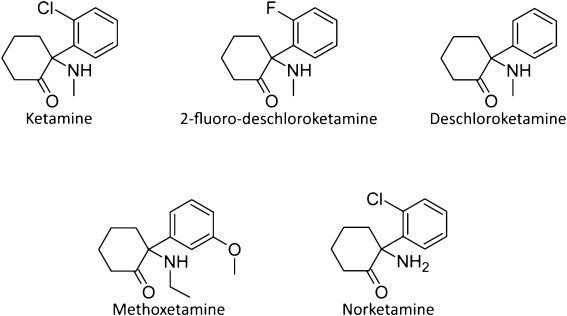
Arylcyclohexylamines are a chemical family characterized by an aryl group and a cyclohexylamine-related structure.
Ketamine is one of the best-known members of this broad family.
Other compounds discussed in scientific and forensic literature include:
- O-PCE;
- 2-FDCK;
- deschloroketamine;
- fluorexetamine;
- hydroxetamine;
- methoxetamine.
These compounds have attracted interest because emerging arylcyclohexylamines can appear in drug markets before extensive scientific information becomes available.
That makes ketamine analogue research important for laboratories and monitoring agencies.
Why is ketamine analogue research important?
There are several reasons why scientists study these compounds.
Chemical identification
New analogues need to be distinguished from ketamine and other structurally related substances.
Metabolism
Researchers need to know which metabolites may appear in blood, urine, hair and other samples.
Toxicology
Clinical and forensic studies help document adverse events and improve interpretation of exposure.
Analytical chemistry
Laboratories need validated techniques for detecting unfamiliar compounds.
European monitoring
Drug-monitoring agencies track the emergence and changing availability of new analogues.
The EUDA’s 2026 material highlights the importance of monitoring emerging psychoactive substances and improving analytical awareness as European markets evolve.
O-PCE: an arylcyclohexylamine of research interest
O-PCE, also known as 2-oxo-PCE or deschloro-N-ethylketamine, is an arylcyclohexylamine that has been investigated in toxicological and metabolic research.
A published human case study used several complementary analytical methods, including liquid chromatography with high-resolution tandem mass spectrometry, gas chromatography-mass spectrometry and nuclear magnetic resonance, to investigate O-PCE exposure. The researchers identified 27 O-PCE metabolites through molecular-network analysis and examined the compound’s kinetics in plasma.
This type of study demonstrates why ketamine analogue research extends far beyond simply identifying a chemical name.
Researchers may also need to understand the compound’s metabolic fingerprint.
O-PCE and metabolic research
Metabolism is a major area of ketamine analogue research.
When an arylcyclohexylamine enters a biological system, enzymes can transform the parent molecule into other compounds.
These products are called metabolites.
In the O-PCE case study, researchers identified numerous metabolites, including phase-II compounds that had not previously been reported. The work suggested that some metabolites could potentially serve as surrogate biomarkers in toxicological testing.
This is valuable because laboratories may encounter biological samples in which the parent compound is no longer easily detectable.
2-FDCK: another important research compound
2-FDCK, or 2-fluorodeschloroketamine, is another arylcyclohexylamine that has been investigated extensively through laboratory and forensic studies.
Researchers first reported detecting 2-FDCK in patient urine and subsequently confirmed its identity using accurate-mass analysis and a reference standard.
A clinical case series involving 20 analytically confirmed 2-FDCK exposures documented neurological and cardiovascular effects and identified several metabolites, including nor-2F-DCK and dehydronor-2F-DCK.
This work is an important example of how ketamine analogue research connects analytical chemistry with clinical toxicology.
2-FDCK and laboratory analysis
Researchers have used several methods to study 2-FDCK.
A forensic study investigated 2-FDCK in whole blood and hair samples, using toxicokinetic analysis and laboratory methods designed to characterize the compound in biological matrices.
Another study investigated 2-FDCK metabolism using:
- human liver microsomes;
- HepaRG cells;
- high-resolution accurate-mass spectrometry;
- post-mortem biological samples.
The researchers identified 13 metabolites in vitro and several additional metabolites in post-mortem samples.
These findings show how ketamine analogue research can involve several experimental models and analytical platforms.
O-PCE vs 2-FDCK
Although O-PCE and 2-FDCK are both arylcyclohexylamines, they are not the same compound.
Their structures contain different substituents, and researchers have identified different metabolic pathways.
| Characteristic | O-PCE | 2-FDCK |
|---|---|---|
| Chemical family | Arylcyclohexylamine | Arylcyclohexylamine |
| Common alternate name | 2-oxo-PCE | 2-fluorodeschloroketamine |
| Metabolism studied | Yes | Yes |
| Human/forensic research | Yes | Yes |
| Mass-spectrometry research | Yes | Yes |
| Metabolites reported | Multiple | Multiple |
The comparison demonstrates a basic principle of ketamine analogue research: related structures can still require separate scientific evaluation.
Why structural differences matter
Arylcyclohexylamine chemistry provides a useful example of structure–activity relationships.
Changing a substituent can potentially influence:
- molecular size;
- electronic properties;
- receptor interactions;
- metabolism;
- analytical retention;
- fragmentation patterns.
For researchers, this means an analogue should not be treated as a direct chemical equivalent of ketamine simply because the compounds belong to the same family.
That principle is central to ketamine analogue research.
How laboratories identify ketamine analogues Research
One of the most important applications of ketamine analogue research is analytical identification.
A laboratory may use several complementary techniques.
Liquid chromatography
Liquid chromatography separates compounds in complex samples.
Mass spectrometry
Mass spectrometry provides information about molecular mass and fragmentation.
LC-MS/MS
Tandem mass spectrometry can provide selective detection of known targets.
High-resolution mass spectrometry
High-resolution instruments can help identify unknown substances and metabolites with accurate-mass data.
Gas chromatography-mass spectrometry
GC-MS can be useful for appropriate compounds and sample matrices.
Nuclear magnetic resonance
NMR can provide detailed structural information and may complement chromatographic and mass-spectrometric methods.
Why reference standards matter
Reference standards are important because laboratories need known material for comparison.
A reference standard can help researchers evaluate:
- retention time;
- mass spectra;
- calibration;
- analytical identity;
- concentration.
When a new analogue appears, reference material may initially be scarce.
This can make ketamine analogue research particularly challenging during the early stages of an emerging-substance investigation.
The importance of accurate-mass analysis
High-resolution mass spectrometry has become increasingly useful in emerging-drug analysis.
It allows researchers to examine precise molecular masses and identify potential metabolites.
The 2-FDCK studies demonstrate how accurate-mass analysis can help confirm compound identity and investigate previously unknown metabolic products.
The O-PCE literature similarly demonstrates how high-resolution tandem mass spectrometry can be combined with other methods to establish a detailed metabolic profile.
Ketamine analogues and metabolites
Metabolite research is one of the fastest-growing areas within ketamine analogue research.
Researchers can investigate:
Parent compound
The original substance.
Phase-I metabolites
Products formed through reactions such as oxidation or other transformations.
Phase-II metabolites
Conjugated products generated through further biological processing.
Potential biomarkers
Metabolites that may be particularly useful for analytical detection.
The exact metabolic pathway depends on the individual compound.
Why urine, blood and hair can tell different stories
Different biological matrices provide different analytical information.
Urine
Urine can contain metabolites that remain after the parent compound declines.
Blood
Blood can provide information about compounds present in circulation.
Hair
Hair offers a different testing matrix and can be useful in some forensic investigations.
Research involving 2-FDCK has demonstrated detection and analysis in both blood and hair, while O-PCE studies have investigated plasma, urine and hair alongside other analytical approaches.
This makes matrix selection an important consideration in ketamine analogue research.
What does toxicology research show?
The toxicological evidence for emerging arylcyclohexylamines remains incomplete, but published studies have documented serious adverse events.
For 2-FDCK, a clinical series reported impaired consciousness, agitation, abnormal behaviour, hypertension and tachycardia. Five of the 20 patients experienced loss of consciousness or convulsions.
Research involving O-PCE has also documented exposure in clinical and forensic settings. A 2026 French study examining ketamine analogues identified O-PCE among substances associated with reported health effects in the French Addictovigilance Network.
These findings show why ketamine analogue research needs to include toxicology as well as chemistry.
Ketamine analogues in Europ
European monitoring of ketamine and related substances has become increasingly important.
The EUDA’s 2026 European Drug Report says ketamine is becoming more embedded in Europe’s drug landscape and notes increasing signals from treatment data and wastewater monitoring.
A 2026 wastewater research publication also reported detecting several ketamine analogues, including 2F-DCK and 2-oxo-PCE, across monitoring sites. 2F-DCK was detected at sites in countries including Belgium, France, Italy, Spain, Sweden and Slovenia.
These findings provide useful evidence for the continuing importance of ketamine analogue research in European monitoring.
Why European monitoring matters
Emerging compounds can appear in different countries at different times.
European monitoring helps identify:
- newly appearing analogues;
- changing availability;
- unexpected substances;
- toxicological signals;
- laboratory findings;
- geographic distribution.
The EUDA’s broader NPS monitoring framework combines information from national early-warning systems, forensic laboratories and other sources.
This makes ketamine analogue research relevant to both laboratory science and European public-health surveillance.
How regulation affects research
The legal environment for arylcyclohexylamines can change as substances become more widely recognized.
European countries may apply different controls according to national legislation, while EU-level measures can influence national implementation.
For that reason, researchers should never assume that a compound is unrestricted simply because it appears on a website under the term “research chemical.”
Current regulation should be checked for:
- the exact compound;
- the country;
- the date;
- the proposed research activity.
This is another reason ketamine analogue research needs accurate regulatory context.
Quality control and research materials
For laboratory-oriented materials, quality information can help researchers understand what they are evaluating.
Useful documentation may include:
Chemical identity
The exact compound name.
Batch number
A unique identifier connecting documentation to a material.
Analytical method
The method used to examine the material.
Analytical result
The actual reported finding.
Testing date
When the sample was analysed.
Laboratory information
Who performed the analysis.
A single purity percentage should not be treated as a complete safety assessment.
Evaluating an O-PCE or 2-FDCK research source
A good source should answer several questions.
Is the chemical identity clear?
Look for an established name and supporting identifiers.
Is the analytical evidence explained?
Determine which laboratory methods were used.
Is the research peer-reviewed?
Peer-reviewed research is generally more useful than unsupported commercial statements.
Is the information current?
Look at publication and update dates.
Are legal claims sourced?
Verify them against current national or European legislation.
These principles improve the quality of ketamine analogue research information available online.
SpaceChems and arylcyclohexylamine research
For SpaceChems, this article can function as the main Arylcyclohexylamine Research pillar.
The article can naturally connect to your existing:
O-PCE information page
2-FDCK information page
Arylcyclohexylamine category
Quality Control page
About SpaceChems page
Related research articles
A useful internal architecture is:
Ketamine Analogue Research
↓
O-PCE research
2-FDCK research
↓
Individual SpaceChems information pages
This gives readers a clear path from general chemistry to compound-specific information.
Recommended internal links
Use contextual anchor text such as:
O-PCE research
2-FDCK research
arylcyclohexylamine research
ketamine analogue research
SpaceChems Quality Control
research chemical laboratory testing
These links should be inserted only where the referenced page actually expands on the subject.
Building the SpaceChems arylcyclohexylamine content cluster
One article should not be expected to answer every search query.
A stronger cluster could include:
Ketamine Analogue and Arylcyclohexylamines
O-PCE Chemistry and Metabolism
2-FDCK Chemistry and Laboratory Analysis
Arylcyclohexylamine Metabolites Explained
How Laboratories Identify Ketamine Analogue
Ketamine Analogue in European Monitoring
This structure creates a broader knowledge network around the topic.
It also gives Google multiple pages covering different aspects of the same subject.
Common misconceptions
“Every ketamine analogue is the same.”
No. They are distinct chemical compounds.
“A similar structure guarantees identical effects.”
No. Structural similarity does not establish identical pharmacology or toxicology.
“A product name proves chemical identity.”
No. Laboratory analysis provides stronger evidence.
“One purity number proves safety.”
No. Purity and safety are separate concepts.
“Research chemical means legal.”
No. The term itself does not determine legal status.
“Older articles are always reliable.”
No. Scientific evidence, market conditions and regulations can change.
Understanding these misconceptions is an important part of ketamine analogue research.
Frequently asked questions
What are ketamine analogues?
Ketamine analogues are compounds structurally related to ketamine. Many belong to the broader arylcyclohexylamine family.
What is O-PCE?
O-PCE, also called 2-oxo-PCE or deschloro-N-ethylketamine, is an arylcyclohexylamine that has been investigated in analytical and toxicological research.
What is 2-FDCK?
2-FDCK is the abbreviation for 2-fluorodeschloroketamine, an arylcyclohexylamine investigated in clinical, forensic and metabolic research.
Are O-PCE and 2-FDCK the same compound?
No. They are separate compounds with different structures and metabolic profiles.
Why is ketamine analogue research important?
It helps researchers understand chemical identity, metabolism, laboratory detection, toxicology and emerging European trends.
Can laboratories detect O-PCE and 2-FDCK?
Yes. Published studies have used chromatography, mass spectrometry, high-resolution mass spectrometry and NMR to investigate these compounds.
Can metabolites be detected?
Yes. Research has identified multiple metabolites of both O-PCE and 2-FDCK.
Why are metabolites important?
Metabolites can remain detectable after the parent compound declines and can therefore be useful in certain toxicological investigations.
Are ketamine analogues monitored in Europe?
Yes. European monitoring systems track emerging psychoactive substances, while recent scientific work has documented ketamine analogues such as 2F-DCK and O-PCE in European monitoring data.
Are ketamine analogues automatically legal because they are called research chemicals?
No. Legal status depends on the individual substance and jurisdiction.
Where can current European regulatory information be checked?
Use current legislation and official sources from the relevant European country or EU institutions rather than relying on old commercial descriptions.
Conclusion
Ketamine analogue research is becoming increasingly relevant as European laboratories and monitoring agencies encounter a broader range of arylcyclohexylamines.
Compounds such as O-PCE and 2-FDCK demonstrate why detailed scientific analysis is necessary. Research has examined their molecular structures, metabolites, toxicokinetics, laboratory detection and toxicological significance.
The wider European picture is also changing. EUDA’s 2026 reporting identifies growing concern surrounding ketamine in Europe, while research data demonstrate that related analogues can appear across multiple European monitoring sites.
For laboratories and researchers, the most reliable approach is to combine precise chemical identification, validated analytical methods, peer-reviewed literature and current regulatory information.
For SpaceChems, this article can act as a central ketamine analogue research resource linking the broader arylcyclohexylamine category with detailed O-PCE and 2-FDCK articles and relevant quality-control information.
As new compounds appear and scientific knowledge develops, this resource should be updated regularly so that researchers and readers are working from current evidence rather than outdated descriptions.
