

Fluorinated Stimulant Research
4-Fluoroamphetamine Research: Chemistry, Analysis and European Regulation
Sep
4-fluoroamphetamine research has become increasingly relevant to analytical chemistry, forensic toxicology and European drug monitoring.
Commonly abbreviated as 4FA, 4-fluoroamphetamine is a substituted amphetamine whose chemical structure and pharmacological properties have been investigated in scientific and toxicological research. It is also known by names including 4-FMP, PFA, and para-fluoroamphetamine.
For researchers and readers searching for reliable information about 4FA in Europe and Greece, understanding the chemistry, laboratory identification, toxicology and regulatory environment is more useful than relying on outdated descriptions found on research-chemical websites.
This article examines the scientific identity of 4-fluoroamphetamine, how laboratories analyse it, what research has reported about its pharmacology and risks, and why current European and national regulations need to be checked carefully.
Research and legal notice: 4-fluoroamphetamine is a psychoactive controlled substance in multiple jurisdictions. This article is intended for scientific and educational purposes and does not provide instructions for human use, dosing, procurement or evasion of drug controls.
What is 4-fluoroamphetamine?
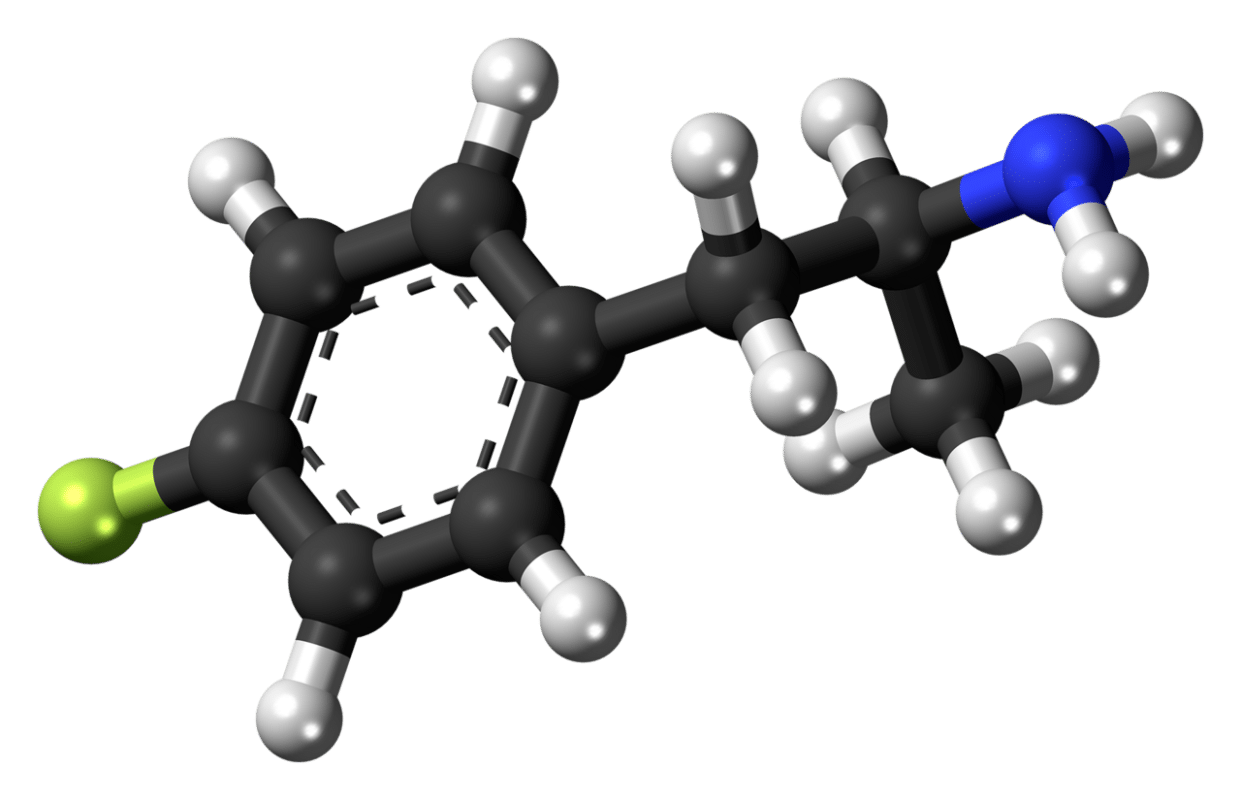
4-fluoroamphetamine, or 4FA, is a ring-substituted derivative of amphetamine.
The chemical name is:
1-(4-fluorophenyl)propan-2-amine
The compound contains a fluorine atom at the para, or 4-position, of the phenyl ring. This structural modification distinguishes 4-FA from unsubstituted amphetamine and from other fluoroamphetamine positional isomers.
The United Nations Office on Drugs and Crime identifies 4-fluoroamphetamine as a stimulant in the phenethylamine group and lists the CAS number 459-02-9, molecular formula C9H12FN, and molecular weight approximately 153.2 g/mol.
The WHO Expert Committee on Drug Dependence has also reviewed 4FA and describes it as a psychomotor stimulant and ring-substituted derivative of amphetamine.
4FA chemical structure
The chemistry of 4-fluoroamphetamine is particularly interesting because fluorination can alter the physical and biological properties of an organic molecule.
For 4FA, the fluorine substituent is attached to the aromatic ring at the para position.
This gives the compound a distinct molecular identity from:
- 2-fluoroamphetamine;
- 3-fluoroamphetamine;
- amphetamine;
- methamphetamine;
- other substituted amphetamines.
Positional isomers can have different pharmacological, metabolic and analytical characteristics. Consequently, laboratories must identify the precise compound rather than treating every fluoroamphetamine as equivalent.
What names are used for 4FA?
Researchers may encounter several names for the same compound.
Common terminology includes:
4-FA
4-fluoroamphetamine
4-FMP
PFA
para-fluoroamphetamine
The IUPAC chemical name is:
1-(4-fluorophenyl)propan-2-amine.
Including recognized synonyms is valuable when searching scientific databases because different publications and chemical-reference systems may use different terminology.
Why is 4-fluoroamphetamine studied?
Research involving 4FA covers several scientific disciplines.
Analytical chemistry
Laboratories study how 4FA can be separated, identified and quantified.
Pharmacology
Researchers investigate its interaction with monoamine transport systems and related biological pathways.
Toxicology
Clinical and forensic scientists study adverse effects associated with exposure.
Forensic science
4FA can be investigated in biological samples and seized materials.
Drug monitoring
European agencies monitor the emergence and changing availability of synthetic and semi-synthetic stimulant compounds.
The WHO notes that 4FA has been detected in Europe since at least the late 2000s and that seizures have occurred across multiple countries.
4-FA and neurotransmitter research
One reason 4-fluoroamphetamine research has attracted scientific attention is its relationship to monoamine neurotransmitter systems.
The WHO review describes 4FA as functioning as a substrate of monoamine transporters and a releasing agent affecting dopamine, norepinephrine and serotonin systems in nonclinical research.
These mechanisms are relevant to research into psychostimulants because changes in monoamine signalling can influence numerous neurological and physiological processes.
However, findings from laboratory models should not automatically be interpreted as a prediction of a specific response in every human being.
4-FA laboratory analysis
Accurate identification is one of the most important parts of research involving emerging stimulants.
Laboratories can use several analytical techniques.
Liquid chromatography
Liquid chromatography can separate compounds within a complex sample.
When paired with mass spectrometry, it can provide information useful for detecting and characterising 4-FA.
LC-MS and LC-MS/MS
Liquid chromatography combined with mass spectrometry is widely used in forensic and toxicological analysis.
It can provide information about molecular mass and characteristic fragmentation patterns.
Gas chromatography-mass spectrometry
GC-MS is another established analytical technique used in forensic chemistry and toxicology for suitable substances.
High-resolution mass spectrometry
High-resolution systems can provide highly accurate mass measurements, helping distinguish compounds with similar molecular structures.
Using complementary analytical techniques improves confidence in the identity of an unknown sample.
Why chemical identification matters
Synthetic stimulants can be difficult to distinguish based purely on appearance.
A powder or tablet cannot reliably establish chemical identity.
Laboratory analysis is therefore important for determining:
- the actual compound present;
- whether multiple substances are present;
- the molecular identity;
- the concentration;
- potential degradation products;
- relevant metabolites.
This issue becomes particularly important when compounds have similar names or closely related structures.
What does research say about the effects of 4-FA?
Available scientific evidence describes 4-FA as a psychostimulant with amphetamine-like and entactogen-like characteristics.
The WHO review notes that nonclinical studies found effects predictive of stimulant and abuse-related activity, including locomotor activation, amphetamine-like discriminative stimulus effects and self-administration.
Human evidence, however, is not as extensive as the literature available for older pharmaceutical or recreational stimulants.
This distinction matters when evaluating online claims about the compound.
A research article should distinguish:
laboratory findings
from
animal research
and
observations from human cases.
4-FA and toxicology
The toxicological literature contains reports of serious adverse events associated with 4-FA.
Published medical literature has described cardiovascular complications, including severe cardiovascular toxicity. One report described acute heart failure associated with 4-FA exposure.
The historical WHO assessment also noted reports of adverse reactions requiring hospitalization and cases resulting in death.
These findings mean that 4-FA should not be described as a substance with an established safety profile.
They also illustrate why accurate analytical identification is important in emergency medicine and forensic toxicology.
4-FA and Europe
Europe has played a significant role in monitoring 4-fluoroamphetamine.
The WHO’s scientific reviews document detection of 4-FA in numerous European countries and describe its appearance in tablets marketed as MDMA or “ecstasy,” amphetamine-type powders and other illicit products.
The EUDA’s current European drug reports continue to emphasize that Europe’s stimulant market is evolving rapidly and that improved forensic and toxicological analysis is important for identifying emerging compounds.
This makes 4-FA Europe a useful informational topic for researchers, toxicologists and people studying European drug trends.
4-FA regulation in Greece
For anyone searching for 4-FA Greece, current legal information is particularly important.
Older scientific reports stated that 4-FA was not controlled in Greece at the time of those historical reviews. That information is no longer an adequate basis for determining the current position.
Greek official material subsequently listed 4-fluoroamphetamine (4-FA) in Table A of controlled narcotic substances. The Greek police’s annual narcotics report identifies 4-fluoroamphetamine in that table.
A Greek government publication from 2018 also explicitly records:
4-fluoroamphetamine (4-FA) — 4-φθοροαμφεταμίνη
under Table A.
Because controlled-substance regulations can change, anyone dealing with a current legal question should verify the latest Greek legislation rather than relying on historical research papers.
4-FA regulation in the Netherlands
The Netherlands is another important jurisdiction to distinguish from older website claims.
The Dutch government added 4-FA to List I of the Opium Act in 2017, describing it as 4-fluoramfetamine.
The current consolidated Dutch List I in force from July 2026 continues to include 4-FA / 4-fluoramfetamine.
This is particularly relevant because some online product pages still describe 4-FA as “legal in the Netherlands.” Such statements should be corrected rather than repeated.
4-FA regulation in the United States
The U.S. position also changed recently.
On January 15, 2026, the U.S. Drug Enforcement Administration issued a final rule placing 4-fluoroamphetamine, including its salts and isomers, in Schedule I of the Controlled Substances Act. The rule states that it became effective on February 17, 2026.
This is a significant update for any international website discussing 4-FA.
An article written before February 2026 may therefore contain outdated information about U.S. regulatory status.
Why researchers should use current regulatory sources
A recurring problem with research-chemical information online is that legal descriptions often remain unchanged for years.
A page may have been written when a compound was:
- unscheduled;
- newly identified;
- subject to a temporary measure;
- regulated under a different classification.
That historical status may no longer apply.
For 4-FA, researchers should consult current official sources in the country concerned.
Useful sources include:
- EUDA;
- national government legislation;
- official gazettes;
- drug-control authorities;
- forensic laboratories;
- peer-reviewed scientific literature.
Evaluating 4-FA research material
When evaluating a 4-FA research source, look beyond phrases such as “premium,” “high purity,” or “laboratory grade.”
A more useful evaluation asks:
Is the chemical identity clearly stated?
Is there batch or analytical documentation?
Are laboratory methods identified?
Are claims supported by independent references?
Is the material legally permissible for the intended research?
Has the relevant country’s current law been checked?
These questions are more useful for scientific quality assessment than marketing language alone.
4-FA information on SpaceChems
SpaceChems currently lists 4FA Powder under its Fluorinated research-chemical category. The live page identifies 4FA as 4-fluoroamphetamine and provides additional chemical and research-oriented information.
For readers researching supplier information, SpaceChems also has an About Us page describing its stated quality-control approach and scientific focus, together with dedicated information pages including Quality Control, Disclaimer, Terms & Conditions and Warranty & Complaints.
Any quality or purity claim, however, should ideally be supported by documentation tied to the specific batch being discussed.
Frequently asked questions about 4-fluoroamphetamine
What is 4-fluoroamphetamine?
4-fluoroamphetamine, or 4-FA, is a ring-substituted amphetamine also known as 4-FMP or para-fluoroamphetamine.
What is the molecular formula of 4-FA?
The molecular formula is C9H12FN, with a molecular weight of approximately 153.2 g/mol.
What is the CAS number for 4-fluoroamphetamine?
The commonly listed CAS Registry Number is 459-02-9.
Is 4-FA the same as amphetamine?
No. 4-FA is a structurally modified amphetamine containing a fluorine atom at the para position of the phenyl ring.
How is 4-FA detected?
Laboratories can use analytical approaches such as chromatography and mass spectrometry to identify and quantify 4-FA.
Is 4-FA regulated in Greece?
Greek official sources have listed 4-fluoroamphetamine in Table A of controlled narcotic substances. Current Greek legislation should be checked for the applicable legal position at the time of research.
Is 4-FA controlled in the Netherlands?
Yes. 4-FA was placed in List I of the Dutch Opium Act in 2017 and remains listed in the current consolidated List I.
Is 4-FA controlled in the United States?
Yes. The DEA placed 4-fluoroamphetamine in Schedule I, effective February 17, 2026.
Does 4-FA have an established safety profile?
No. Published toxicological evidence includes serious adverse events, so it should not be described as having an established safety profile.
Conclusion
4-fluoroamphetamine research covers chemistry, analytical science, pharmacology, toxicology and forensic investigation.
The compound has a well-defined molecular identity and has been investigated as a substituted amphetamine affecting monoamine systems. Its appearance in European monitoring and toxicological records has also made it an important subject for analytical laboratories.
The regulatory picture has changed considerably over time. Greece has listed 4-FA in Table A, the Netherlands continues to list it under List I of the Opium Act, and the United States classified it under Schedule I effective February 17, 2026.
For researchers, the most important principles are straightforward: use precise chemical identifiers, rely on credible laboratory and scientific evidence, distinguish experimental findings from human evidence, and verify the law applicable to the specific jurisdiction and date.
